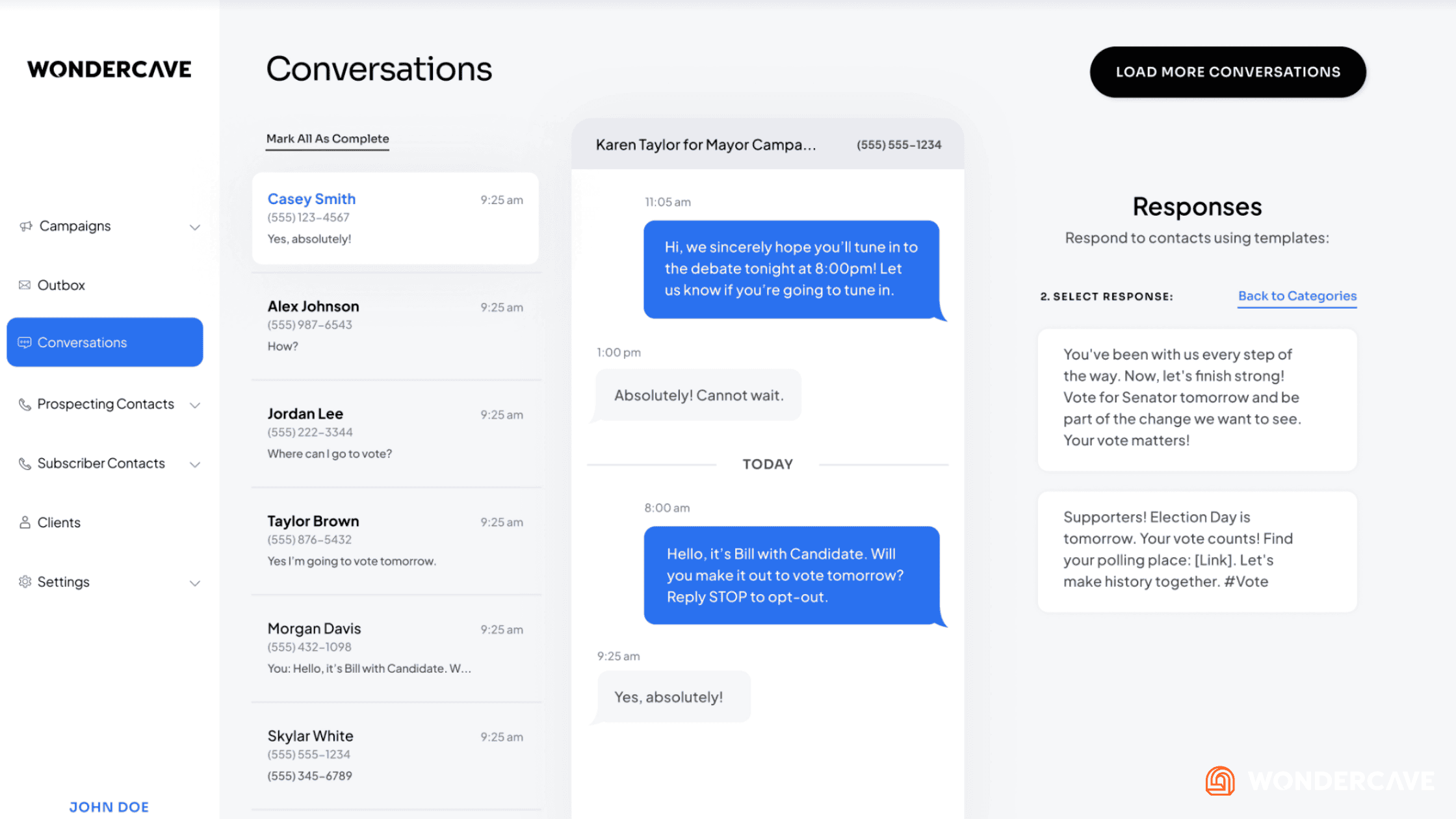
In the political space, two-way political texting has become a buzzword. Every platform claims to offer “real conversations at scale.” Every consultant says they’re building engagement, not just sending messages.
But here’s the truth: not every campaign needs conversation.
And not every use case benefits from two-way messaging.
If you treat two-way political texting like a universal solution, you will waste time, increase cost, and create unnecessary operational complexity. If you deploy it strategically, however, it becomes one of the most powerful persuasion and donor reactivation tools available in modern campaigns.
The difference lies in intent.
When Two-Way Political Texting Does Not Add Value
There are moments in a political cycle where conversation is not the goal. Speed and clarity are.
1. Simple GOTV Reminders – Where Two-Way Can Quietly Win
If you are sending:
- Polling location reminders
- Early vote hours
- Ballot cure deadlines
- Election Day countdown messages
The default assumption is that the objective is awareness and action, not dialogue. But dismissing two-way political texting in GOTV is often a missed opportunity.
Because the real question is not whether voters need a conversation. The question is whether friction exists between reminder and action.
In high-turnout environments, friction is rarely about motivation alone. It is about uncertainty:
- “Where exactly is my polling place?”
- “What time do they close?”
- “Do I need ID?”
- “Can I still early vote?”
A one-way message with a generic link may inform. A two-way message can convert.
When two-way political texting is deployed strategically in GOTV, it enables:
- Polling place lookup via reply keywords
- Branded links that build trust and avoid spam filtering
- Real-time clarification on ballot cure or ID requirements
- Rapid segmentation of voters who need follow-up
This is not about opening unlimited conversations. It is about controlled responsiveness.
For example:
- “Reply POLL to get your polling location.”
- “Reply HOURS for today’s voting times.”
That structure keeps the workflow efficient while allowing voters to pull information when they need it.
Even more importantly, two-way texting can turn a passive contact into a committed voter. A supporter who replies with a question is signaling engagement. That interaction can be logged, segmented, and followed up with tailored mobilization messaging.
The risk is not in enabling replies. The risk is enabling replies without infrastructure.
If delivery is unstable, branded links are inconsistent, or response monitoring is delayed, two-way becomes operational chaos. But when built on reliable, compliance-first infrastructure, it becomes a friction-reduction engine.
In pure transactional reminders, one-way may be sufficient.
In competitive elections where margins are thin, two-way political texting can be the difference between a reminder sent and a vote cast.
2. High-Volume Fundraising Blasts
When the goal is to drive immediate small-dollar contributions from an already warm list, conversation is not always necessary.
If:
- The donor already trusts the campaign
- The ask is clear
- The link is frictionless
Adding conversational branching can reduce throughput and slow send velocity.
Two-way political texting is not a replacement for disciplined fundraising architecture. It is an amplifier when persuasion or hesitation is present.
When Two-Way Political Texting Really Becomes Leverage
Where two-way political texting truly works is when belief, education, or trust must be rebuilt.
This is where infrastructure and strategy intersect.
1. Persuasion Campaigns
If you are trying to move undecided voters, issue skeptics, or soft supporters, broadcasting information is rarely enough.
Two-way texting allows:
- Real-time objection handling
- Clarification of misinformation
- Tailored follow-up messaging
- Dynamic segmentation based on response
Persuasion requires listening. Without inbound response capability, you are guessing.
When executed properly, two-way political texting transforms outreach from static messaging into iterative engagement.
2. Advocacy Education for 501(c)(4)s
In the advocacy space, awareness does not automatically convert to action.
A recent 501(c)(4) in the technology sector had thousands of engaged supporters. Email open rates were strong. Social engagement looked healthy. But when it came time to drive legislative outreach, participation lagged.
Instead of blasting reminders, they implemented two-way political texting focused on conversation.
The results:
- Over 1,000 direct supporter conversations
- 100+ legislative outreach conversions
- Nearly 99% delivery performance
The key was not simply “two-way capability.” It was reliable infrastructure that ensured messages reached inboxes and responses were processed quickly.
When supporters feel heard, action increases.
Two-way political texting works when education is required before mobilization.
3. Donor Reactivation
Small-dollar donors pull back for a reason. This could be fatigue, trust erosion or message saturation.
Reactivation requires understanding the friction.
Two-way political texting allows campaigns to:
- Ask why a donor stopped giving
- Clarify how funds are being used
- Segment based on response sentiment
- Personalize follow-up appeals
This approach shifts the dynamic from extraction to relationship building.
And in a crowded 2026 environment, relationship equity matters more than volume.
When Two-Way Political Texting Fails
The common misconception is that enabling replies automatically creates engagement. It does not.
Two-way political texting fails when:
- Delivery is inconsistent
- Response times are slow
- Compliance controls are weak
- Staff is untrained
- Conversations are not logged or segmented
Invisible filtering from carriers can quietly suppress inbound or outbound messages. If infrastructure is unstable, conversations collapse before they begin.
Conversation without reliability is a risk.
This is why infrastructure decisions made in Q1 determine engagement quality in Q3.
The Strategic Framework
Before launching two-way political texting, campaigns should ask:
- Is persuasion required, or just mobilization?
- Is education necessary before action?
- Are we prepared to monitor and respond in real time?
- Do we trust our deliverability at scale?
- Can we segment based on conversation outcomes?
If the answer to these questions is no, two-way will feel chaotic. If the answer is yes, it becomes leverage.
The 2026 Reality
As carriers continue to tighten trust scoring and filtering rules, conversational messaging will require stronger infrastructure, not just better copy.
Political teams that treat two-way political texting as a strategic persuasion channel, rather than a feature checkbox, will outperform in:
- Advocacy conversions
- Donor reactivation
- Relationship-based fundraising
- Issue education campaigns
The takeaway is simple:
Not every message deserves a reply.
But when belief, trust, or hesitation stand between you and action, two-way political texting becomes one of the most powerful tools in your arsenal.
And when built on stable, compliance-first infrastructure, it shifts from “engagement tactic” to measurable advantage.