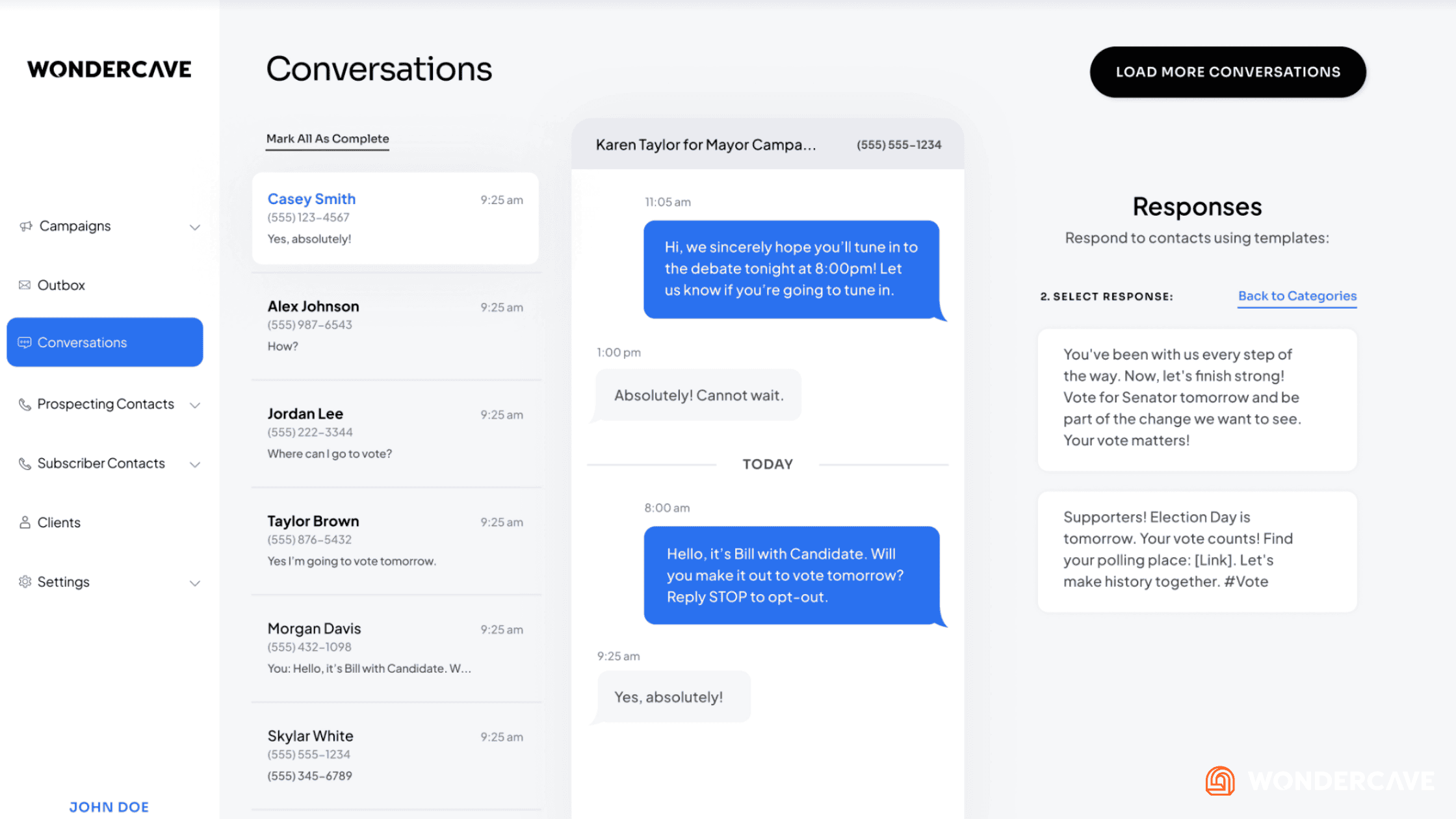
Political texting programs rarely fail at the start. They fail when they scale.
What works for a small persuasion list or early fundraising push often collapses when volume spikes, timelines compress, and carrier scrutiny intensifies. Messages don’t bounce. Dashboards look normal. But engagement drops, replies slow, and entire sends quietly underperform.
It’s usually not a campaign problem , it’s an infrastructure one.
This guide breaks down how to build a scalable political texting program that holds up under real campaign pressure, so growth doesn’t turn into a liability.
Scaling Isn’t About Sending More Messages
It’s about the platform withstanding the stress.
Most political texting programs are built to launch, not to scale.
Early decisions, often made under tight timelines, determine whether your program can survive:
- Rapid list growth
- GOTV or fundraising surges
- Carrier trust scoring changes
- Compliance audits mid-cycle
- Multiple stakeholders sending at once
Scaling safely means assuming those stresses will happen, and engineering for them before volume ramps.
That’s why you need a political texting platform that is built for the speed and scale of politics!
The Hidden Failure Mode of “Successful” Early Programs
Early success creates false confidence.
If your first few sends perform well, it’s tempting to assume:
- The setup is solid
- Deliverability is “handled”
- Compliance is good enough
- Scale will just work
In reality, small-volume success masks structural weaknesses.
Carriers evaluate behavior over time:
- Volume acceleration
- Consistency
- Reply patterns
- Opt-out handling
- Sender reputation across campaigns
When scale hits, those weak spots surface, often when it’s too late to fix them.
Infrastructure Decision #1: Registration Is a Foundation, Not a Checkbox
Many teams treat sender registration as a hurdle to clear so they can start texting. That’s backwards.
Registration defines:
- Who carriers believe you are
- What volume you’re trusted with
- How aggressively your traffic is filtered
- How forgiving networks are during spikes
A scalable political texting program assumes:
- Registration will be reviewed, not just approved
- Use cases will expand over time
- Volume patterns will change mid-cycle
If your registration only describes “occasional updates,” but you later run GOTV-scale sends, you’ve created a trust mismatch that shows up as silent blocking.
Infrastructure Decision #2: Throughput Control Beats Raw Speed
Fast sending feels powerful, until it backfires.
Carriers care less about how fast you can send and more about how predictably you behave.
Programs that fall apart at scale usually:
- Dump too much volume at once
- Spike sends without warming
- Share throughput across unrelated campaigns
- Treat peak moments as exceptions instead of expected events
Scalable political texting uses:
- Controlled ramps
- Campaign-aware pacing
- Predictable daily and hourly patterns
- Separate lanes for high-risk sends
The goal isn’t speed. It’s survivability under pressure and reliability.
Infrastructure Decision #3: Compliance Must Hold at Volume
Opt-outs, disclosures, and consent handling don’t just protect you legally, they affect carrier trust.
At scale, small compliance gaps multiply:
- Delayed STOP handling
- Inconsistent disclosure language
- List sources that can’t be clearly explained
- Replies routed incorrectly during high volume
Carriers don’t evaluate these in isolation. They evaluate patterns.
A scalable program assumes:
- Compliance errors will be audited
- Volume magnifies mistakes
- Manual fixes won’t keep up
If compliance relies on humans catching edge cases, scale will break it.
Infrastructure Decision #4: Visibility Into What You Can’t See
The most dangerous texting failures don’t show up as errors.
Messages aren’t rejected. They’re just not delivered.
Without visibility into:
- Silent filtering
- Trust score decay
- Carrier-level behavior
- Engagement erosion over time
Teams misdiagnose the problem:
- “The list is bad”
- “People are fatigued”
- “This issue just isn’t resonating”
A scalable political texting program separates:
- Messaging performance
from
- Delivery performance
If you can’t tell the difference, scale becomes guesswork.
Infrastructure Decision #5: Platform Accountability Under Stress
When things go wrong at scale, the question isn’t if something breaks, it’s who owns the fix.
Programs fail when:
- Support disappears during peak moments
- No one can explain delivery drops
- “Try sending less” is the only advice
- Accountability is vague
Scalable systems are built with:
- Proactive monitoring
- Human escalation paths
- Clear ownership of deliverability issues
- Partners who expect pressure, not avoid it
If your platform only works when things are calm, it’s not built for campaigns.
What a Scalable Political Texting Program Actually Looks Like
Before you scale, you should be able to answer:
- What happens if volume doubles overnight?
- How do carriers see our traffic today vs. last month?
- Where would silent blocking show up first?
- Which risks increase during GOTV or fundraising spikes?
- Who is accountable if delivery degrades mid-campaign?
If those answers are fuzzy, scale isn’t growth, it’s exposure.
Scaling Should Be Boring, Not Fragile
The best political texting programs don’t feel dramatic when they scale.
They:
- Hold steady during spikes
- Behave predictably under pressure
- Surface risk early
- Absorb growth without rewrites or panic
That stability isn’t accidental. It’s the result of early infrastructure decisions made with scale in mind.
Because in political texting, the cost of getting scale wrong isn’t failure, it’s silence.